Inhaltsübersicht – Zeitschrift für Sport und Recht – Heft 1/2026
Das Heft 1/2026 der SpuRt wird postalisch in der 2. KW zugestellt und ist seit dem 07.01.2026 im Modul Sportrecht plus auf Beck-Online abrufbar.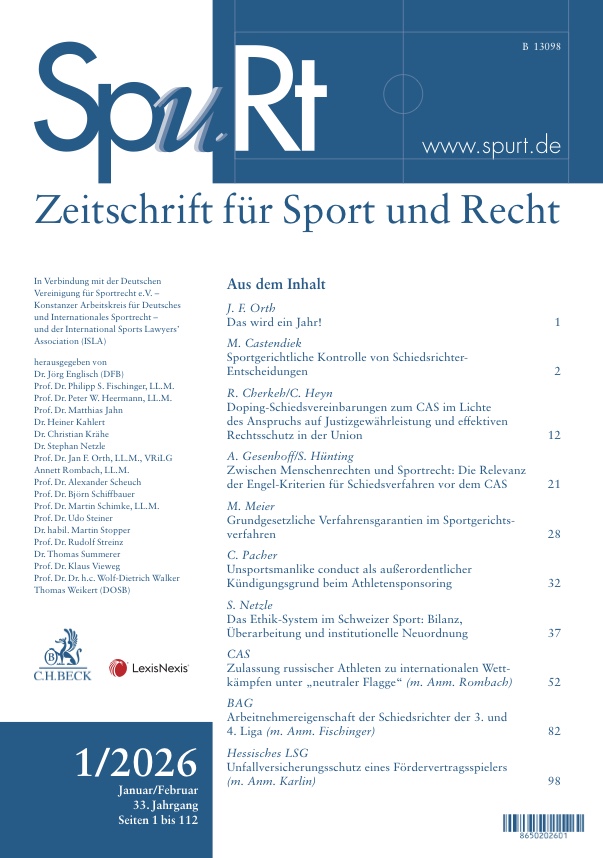
Editorial
- Das wird ein Jahr! (J. F. Orth, S. 1)
Aufsätze
-
Sportgerichtliche Kontrolle von Schiedsrichter-Entscheidungen (M. Castendiek, S. 2)
The article examines the extent to which sports courts can retrospectively review referee decisions in football, distinguishing between match result procedures and subsequent suspensions. It highlights the current practices, criticisms, and alternative proposals, leading to sports law policy demands for better balancing legal certainty and material justice in sports. In the 2024/25 season, sports courts frequently had to assess referee decisions, including a replay in the Women’s Bundesliga due to a referee error and appeals against suspensions following erroneous yellow-red cards in men’s football. The article discusses the legal framework, emphasizing the separation between factfinding (Tatsachenentscheidung) and rule application errors, with sports courts generally bound by the referee’s factual findings. It critiques the division between factual decisions and rule violations, nothing practical and theoretical issues, and explores alternative approaches, such as correcting manifestly wrong factual decisions or adopting the FIFA model of upholding all referee decisions. The article also addresses the limited review of automatic suspensions following personal penalties, suggesting that the current practice may conflict with legal principles and advocating for a return to pre-1997 practices with broader review capabilities. Overall, the article calls for a critical reassessment of the binding nature of referee decisions to enhance fairness and transparency in sports adjudication.
-
Doping-Schiedsvereinbarungen zum CAS im Lichte des Anspruchs auf Justizgewährleistung und effektiven Rechtsschutz in der Union (R. T. Cherkeh / C. Heyn, S. 21)
The article examines the validity of arbitration agreements with the Court of Arbitration for Sport (CAS) in doping disputes, focusing on the athletes“ rights to judicial protection under EU law and the European Convention on Human Rights (ECHR). It highlights criticisms of CAS’s procedural rules, especially regarding public hearings and legal aid, which may not meet European standards. The article discusses the implications of the CAS’s location in Switzerland, a non-EU country, on effective judicial review, referencing the European Court of Justice (ECJ) decisions in the ISU and Seraing cases. These decisions emphasize the need for effective judicial oversight of arbitration awards, particularly when athletes are compelled to accept arbitration. The article argues that the current CAS framework violates both the German constitutional right to judicial protection and EU law, potentially rendering such arbitration agreements invalid. It suggests that athletes should have access to ordinary courts unless arbitration agreements are reformed to ensure compliance with higher legal standards. The authors propose that the CAS’s Swiss location is a significant barrier to effective legal protection, which could be addressed by relocating the arbitration seat to an EU memberstate.
-
Zwischen Menschenrechten und Sportrecht: Die Relevanz der Engel-Kriterien für Schiedsverfahren vor dem CAS (A. Gesenhoff / S. Hünting, S. 21)
The article analyzes the relevance of the Engel criteria for arbitration proceedings before the Court of Arbitration for Sport (CAS) in the context of human rights and sports law. It highlights the European Court of Human Rights“ (ECHR) judgment in Caster Semenya‘s case, underscoring the CAS’s indirect obligation to comply with procedural guarantees under the European Convention on Human Rights (ECHR). The CAS’s legal status and its alignment with Article 6 of the ECHR, which assures the right to a fair trial, are also examined. Although CAS proceedings are generally considered civil, disciplinary actions such as doping bans could carry a quasi-criminal nature, prompting a potential invocation of criminal procedural safeguards. The Engel criteria, established by the ECHR, help discern between civil and criminal proceedings based on aspects like national law classification, the nature of the offense, and the severity of the penalty. Though disciplinary sanctions by sports federations do not typically meet these criteria, exceptions, such as cases involving the French AFLD, may apply. The article argues that while CAS aims for uniformity in handling international sports disputes, diverse procedural requirements based on local law and case specifics challenge this goal. It suggests that a standardized approach in line with the ECHR may be necessary to ensure fair and consistent arbitration practices across different jurisdictions.
-
Grundgesetzliche Verfahrensgarantien im Sportgerichtsverfahren (M. Meier, S. 28) — hier zum Download im Volltext als kostenlose Leseprobe!
The article by explores whether procedural guarantees from Germany’s Basic Law apply to sports tribunal proceedings, which are conducted by private club bodies rather than state courts. It examines the differing constitutional perspectives and aims to balance interests by identifying the constitutional basis for applying these guarantees. The German Federal Court of Justice (BGH) has ruled that exclusion procedures in clubs must meet rule-of-law standards, indicating some consensus in literature and jurisprudence. However, the rationale for this requirement remains debated. Grundnorm principles like the doctrine of Drittwirkung (indirect third-party effects of fundamental rights) are reviewed, suggesting constitutional values influence private legal relationships. The concept of a civil law right to justice (Justizgewährungsanspruch) is introduced as another possible basis, arguing that individuals have a constitutional right to effective legal protection, intending that state courts provide this protection in civil disputes. The requirement for sports tribunal pathways before accessing state courts might undermine this right, necessitating constitutional procedural guarantees in sports proceedings to compensate. The article notes that applying Basic Law’s procedural standards in sports tribunals requires consideration of club autonomy under Article 9 of the Basic Law. The Bundesgerichtshof (BGH) has indicated that procedural standards from state courts shouldn’t be directly imposed on club tribunals but should respect club autonomy. Finally, the article discusses how clubs can define procedural rules within their statutes or bylaws, thus pre-empting state court interventions and aligning with constitutional requirements. It emphasizes the clubs“ opportunity to assert their interests by tailoring procedural rules that reconcile their needs with constitutional expectations.
-
Unsportsmanlike conduct als außerordentlicher Kündigungsgrund beim Athletensponsoring (C. Pacher, S. 32)
The article explores the conditions under which unsportsmanlike conduct can justify the extraordinary termination of an athlete sponsorship in Austria. It underscores the centrality of the athlete’s image in sponsorship agreements, as sponsors aim to leverage the athlete’s popularity and positive public perception to enhance their marketing objectives. It is argued that unsportsmanlike behavior, such as doping or other criminal acts, can severely damage an athlete’s image, risking negative impacts on the sponsor. Sponsorship agreements, which are basically atypical contracts, usually incorporate elements of service, lease, and partnership agreements. These types of contracts inherently create mutual obligations for the parties to safeguard each other’s interests, which, in connection with sponsorships, gives rise to an obligation for the athlete to preserve his image and reputation. Based on this, the article delves into comparable legal frameworks in employment, lease, and corporate law, suggesting that such precedents can inform the justification for extraordinary termination of sponsorships. By examining these legal analogs, it is asserted that sponsors could legitimately sever contracts if the athlete’s actions pose tangible reputational threats. The author specifically concludes that if an athlete’s conduct leads to objectively significant harm or public disapproval for the sponsor, an extraordinary termination is defendable. However, whether such termination is warranted must be determined case-by-case, depending on the justified mutual expectations of trust within the framework of the specific contractual relation.
-
Das Ethik-System im Schweizer Sport: Bilanz, Überarbeitung und institutionelle Neuordnung (S. Netzle, S. 37)
The article discusses the establishment and evolution of Swiss Sport Integrity (SSI), which began operations on January 1, 2022, by merging the Swiss Anti-Doping Agency and a new ethics reporting and investigation unit. The Swiss Sport Ethics Statute, initially enacted in 2021, was revised in 2025 due to the unexpectedly high number of ethics violation reports and the need for procedural improvements. Key changes include the introduction of initial consultations, the possibility of amicable case resolutions, and the expansion of unsporting behavior definitions. The article also highlights the creation of the independent Swiss Sports Court, which began on January 1, 2025, to handle ethics violations, emphasizing its independence and alignment with Swiss and international arbitration standards. The court’s decisions in ethics cases are final, unlike doping cases, which can be appealed to the Court of Arbitration for Sport (CAS). The article notes that the Swiss Sports Court faced criticism for not addressing pre-2022 incidents. Additionally, the Swiss Federal Sports Office (BASPO) ties public funding to ethical compliance, although it does not directly participate in ethics proceedings. The article concludes by emphasizing the importance of prevention and training to reduce ethics violations in Swiss sports.
Rechtsprechung
Kurzübersicht (S. 41)
Internationales
- EuGH: Sportgerichtsbarkeit in Italien und unionsrechtlicher Rechtsschutz (S. 41)
- Provinzgericht Madrid: Zulässige Schadensersatzklage der Superleague-Organisatoren in Spanien (S. 48)
- CAS: Zulassung russischer Athleten zu internationalen Wettkämpfen unter „neutraler Flagge“ (S. 52) (m. Anm. Rombach)
- OLG Köln: Wirksamkeit einer Stufenschiedsklausel mit der NADA zum DISSportSchiedsG und zum CAS (S. 61)
- LG Mannheim: Sexualstraftaten eines Hockey-Profis im eigenen Verein (S. 69)
- VG Berlin: Keine infektionsschutzrechtliche Erstattung bei Covid-19-Quarantäne im Profifußball (S. 77)
Arbeitsgerichtsbarkeit
- BAG: Arbeitnehmereigenschaft der Schiedsrichter der 3. und 4. Liga (S. 82) (m. Anm. Fischinger)
- LAG Rheinland-Pfalz: Politische Äußerungen eines Fubßallprofis als Kündigungsgrund (Fall El Ghazi) (S. 89) (m. Anm. Sura)
Sozialgerichtsbarkeit:
- Hessisches LSG: Unfallversicherungsschutz eines Fördervertragsspielers (S. 98) (m. Anm. Karlin)
Verbandsgerichtsbarkeit
- DTTB-Bundesgericht: Kein Spielabbruch beim Tischtennis wegen großer Hitze in der Halle (S. 103)
- DFB-Bundesgericht: Keine Spielwertung trotz vierter Auswechselung in DFB-Nachwuchsrunde (S. 106)
- WDFV-VG: Zuständigkeit der Sportgerichtsbarkeit nach Spielende (S. 107) (m. Anm. Orth)
Schaufenster
- Karaa / Karaquillo: Les propriétés olympiques (Rez. Kornbeck, S. 110)
- Meier: Grundgesetzliche Verfahrensgarantien im Sportgerichtsverfahren (Rez. Schiffbauer, S. 111)