SpuRt Heft 3/2026
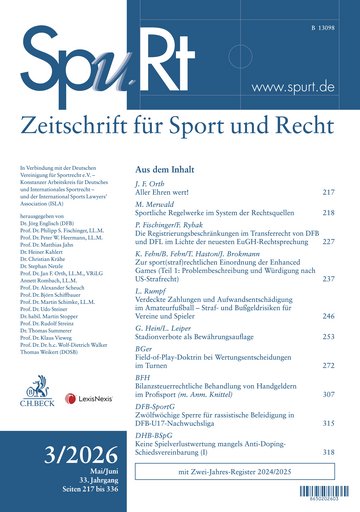
Das Heft 3/2026 der SpuRt wird postalisch in der 20. KW zugestellt und ist seit dem 17.05.2026 im Modul Sportrecht plus auf Beck-Online abrufbar.
Editorial
- Aller Ehren wert! (J. F. Orth, S. 217)
Abhandlungen
-
Sportliche Regelwerke im System der Rechtsquellen (M. Merwald, S. 218)
The article examines the legal status of sports rules within the framework of legal sources. It argues that while sports operate autonomously, they are not exempt from legal scrutiny, particularly in civil and criminal cases involving liability and bodily harm. The article explores the necessity and legitimacy of considering sports rules in legal judgments, focusing on their role in determining liability in sports-related incidents. It highlights that sports rules, although not primary legal sources, influence legal decisions by providing a framework for assessing conduct in sports. The article posits that sports rules should be regarded as secondary legal sources, which means judges are not strictly bound by them but must consider them in their reasoning. This classification ensures consistency and fairness in legal decisions involving sports, as it prevents arbitrary judgments and aligns with the principle of equality under the law. The article concludes that sports rules serve as a starting point for judicial decision-making, akin to precedents, and should be systematically integrated into legal arguments to ensure coherent and persuasive outcomes.
-
Die Registrierungsbeschränkungen im Transferrecht von DFB und DFL im Lichte der neuesten EuGH-Rechtsprechung (P. Fischinger/F. Rybak, S. 227)
The following article critically examines the current legal framework of the German Football Association (Deutscher Fu.ball-Bund e.V., hereinafter “DFB”) and the German Football League (Deutsche Fu.ball Liga e.V., hereinafter “DFL”) governing the registration of players whose employment relationship with their former club has been terminated without notice in light of the so-called Diarra judgment of the Court of Justice of the European Union (CJEU). In a subsequent article in the next issue, proposals for a legally compliant reform will be developed on that basis.
-
Zur sport(straf)rechtlichen Einordnung der Enhanced Games (Teil 1: Problembeschreibung und Würdigung nach US-Strafrecht) (K. Fehn/B. J. Fehn/T. Haston/J. C. Brokmann, S. 237)
The article examines the classification of the “Enhanced Games” under German criminal, professional disciplinary, civil, and sports law. It focuses on a deliberately doping-permissive, commercial sports format that demonstratively distances itself from the WADA regime and the traditional pyramid model of organised sport. The point of departure is the finding that United States federal law does not contain a general criminal anti-doping statute directed at athletes as such. Criminal liability arises there primarily under federal controlled-substances and food-anddrug legislation (CSA, FDCA), the Rodchenkov Anti- Doping Act and general fraud offences, whereas mere self-doping by athletes in the context of the Enhanced Games remains non-criminal under U. S. law. By contrast, the German Act against Doping in Sport (Anti- Doping Act – AntiDopG) establishes a special, systematically self-contained criminal-law regime on doping which deliberately confines criminal liability for self-doping to elite athletes competing in “organised sport” within the meaning of section 3 (3) AntiDopG. As a result, self-doping in connection with the Enhanced Games – despite the health risks involved – remains non-punishable, since these Games do not constitute a competition of organised sport within the meaning of section 3 (3) AntiDopG. With respect to the athletes’ entourage, however, the AntiDopG deploys its full effect: physicians, coaches and other third parties who manufacture, import, trade in, stockpile, administer or possess doping substances typically fulfil the distribution and administration offences set forth in section 4 AntiDopG, supplemented by sections 29 et seq. of the German Narcotics Act (BtMG), section 95 (1) of the German Medicines Act (AMG) and, where applicable, section 224 (1) nos. 1 and 2 of the German Criminal Code (StGB). The distinction between principal liability and secondary participation follows the general German doctrines of control over the act (Tatherrschaft) and organisational control (Organisationsherrschaft). The same applies to athletes where they participate in such doping offences beyond mere self-doping. From a criminal-procedure standpoint, participation in the Enhanced Games, taken in isolation, neither suffices to establish an initial suspicion (Anfangsverdacht) nor, in and of itself, justifies the imposition of coercive investigative measures. Additional, specific factual indications of a prosecutable doping offence are always required. For German-licensed physicians, serious professional-disciplinary and licensing consequences arise in addition. Systematic support of doping amounts to a grave breach of core professional duties and constitutes an indicator of unworthiness or unreliability to practise the medical profession, irrespective of whether the treatment occurs in Germany or at the Enhanced Games venue in the United States. Under German civil law, proven or admitted doping by an athlete will, as a rule, entitle sponsors and commercial partners to terminate sponsorship and endorsement agreements for cause (au.erordentliche Kündigung aus wichtigem Grund), even in the absence of an express anti-doping clause. By contrast, mere participation in the Enhanced Games, without concrete proof of individual doping, constitutes grounds for extraordinary termination only in narrowly circumscribed constellations, namely where there is a demonstrable, material risk of reputational harm to the sponsor or advertising partner. In the realm of sports law, the article shows that national and international sports federations, as well as NADA Germany, are constrained in imposing sanctions – for example under the NADC 21 regime – by competition-law and constitutional standards. A disciplinary exclusion based solely on an athlete’s participation in the Enhanced Games, absent an individualised finding of doping, will as a rule be disproportionate, whereas time-limited suspensions based on a proven violation of recognised anti-doping rules remain in principle permissible. In conclusion, the Enhanced Games operate, from a legal perspective, less as a systemic rupture than as a legal stress test. They delineate the doctrinal limits of the AntiDopG with respect to doping-permissive formats outside the pyramid structure of organised sport and raise the question whether, de lege ferenda, a carefully calibrated expansion of the offence of self-doping and /or flanking measures under competition and association law are warranted in order to preserve a coherent sportslaw framework aimed at protecting athletes’ health and the integrity of competition, even beyond classical federation-based sport.
-
Verdeckte Zahlungen und Aufwandsentschädigung im Amateurfußball – Straf- und Bußgeldrisiken für Vereine und Spieler (L. Rumpf, S. 246) — hier zum Download im Volltext als kostenlose Leseprobe!
The article examines the legal and financial risks associated with undisclosed payments and compensation in German amateur football. As amateur football becomes a significant economic sector, issues like undeclared payments, estimated at up to 500 million EUR annually, pose legal challenges. The article highlights the risks of criminal and administrative penalties for clubs and players, focusing on the misclassification of amateur and contract players as non-employees, leading to failures in tax and social security contributions. Key legal concerns include withholding wages under § 266a StGB and tax evasion under § 370 AO. The article emphasizes the importance of determining whether a player is an employee, which affects the club’s obligations. It also discusses the potential for fines and reputational damage, urging clubs to implement compliance measures. Effective prevention strategies include establishing compliance structures, clear compensation documentation, and regular training for club officials. The article concludes that transparency and adherence to legal obligations are crucial for maintaining the integrity of amateur football, especially as it faces increased scrutiny from authorities.
-
Stadionverbote als Bewährungsauflage (G. Hein/L. Leiper, S. 253)
The article examines the increasing trend of German courts imposing stadium bans as probation conditions under § 56c II Nr. 1 StGB. It begins by discussing the civil law basis for stadium bans, which are generally recognized as valid under German law and supported by the DFB guidelines. The Bundesverfassungsgericht (Federal Constitutional Court) has acknowledged the significant impact of such bans on individuals“ participation in social life, emphasizing the need for careful balancing of interests. In the criminal context, probation conditions aim to prevent future offenses by the convicted individual. The article explores whether stadium bans can serve this purpose, noting that such bans are permissible if they prevent the individual from committing further crimes in specific environments, like sports events. The article argues that stadium bans as probation conditions must comply with constitutional principles, particularly the right to freedom of movement under Art. 11 I GG. The bans must be proportionate, based on concrete evidence of potential future offenses, and clearly defined to avoid ambiguity. The article also addresses potential conflicts with the rights of stadium operators, concluding that the bans do not constitute an unconstitutional economic interference, as they primarily target the convicted individual and not the operators. Overall, the article suggests that while stadium bans can be valid probation conditions, they must be carefully tailored to respect constitutional rights and ensure they serve their intended preventive purpose.
Rechtsprechung
Kurzübersicht (S. 258)
Internationales
- EuGH: Nichtigkeit von Verträgen über Online-Glücksspiele (S. 258)
- Cour d’appel de Paris: Unrechtmäßiger Weiterverkauf von Tickets zu einer Sportveranstaltung in Frankreich über eine Online-Ticketplattform (m. Anm. Schreyer/Preyhs) (S. 266)
- BGer: Field-of-Play-Doktrin bei Wertungsentscheidungen im Turnen (S. 272)
- BGer: CAS-Ad-hoc-Schiedsspruch: Bindung bereits mit Mitteilung des Tenors (S. 275)
- BGer: Revision eines CAS-Ad-hoc-Schiedsspruchs wegen nachträglicher Videoaufnahme (S. 279)
- BGer: Keine Revision wegen unterbliebener Anfechtung einer Field-of-Play-Entscheidung (S. 284)
- ÖOGH: Kartellrechtliche Grenzen für Kennzeichnungsregeln im internationalen Skisport (S. 286)
Ordentliche Gerichtsbarkeit
- LG Zweibrücken: Unzureichend begründeter Durchsuchungsbeschluss und fehlender Anfangsverdacht nach dem Anti-Doping-Gesetz (S. 293)
Arbeitsgerichtsbarkeit
- ArbG ArbG Brandenburg an der Havel: Nebentätigkeit eines Cheftrainers in der „Baller League“ (m. Anm. Jakob) (S. 296)
- ArbG Hannover: Befristung des Arbeitsverhältnisses eines Sportlichen Leiters (S. 299)
- ArbG Düsseldorf: Einsatzabhängige Punkteprämie eines Profifußballspielers (S. 301)
Finanzgerichtsbarkeit
- BFH: Zur Umsatzbesteuerung von Leistungen eines gemeinnützigen Sportvereins (S. 304)
- BFH: Bilanzsteuerrechtliche Behandlung von Handgeldern im Profisport (m. Anm. Knittel) (S. 307)
Verbandsgerichtsbarkeit
- DFB-Sportgericht: Angeblicher Irrtum des Schiedsrichters bei zweiter Gelber Karte (m. Anm. Reif) (S. 313)
- DFB-Sportgericht: Zwölfwöchige Sperre für rassistische Beleidigung in DFB-U17-Nachwuchsliga (S. 315)
- DFB-SportG: Hohe Geldstrafe für „Affenlaute“ durch Anhänger in der DFB-U17-Nachwuchsliga (S. 316)
- DHB-BG: Keine Spielverlustwertung mangels Anti-Doping- Schiedsvereinbarung (III) (S. 318)
- DHB-BSpG: Keine Spielverlustwertung mangels Anti-Doping- Schiedsvereinbarung (I) (S. 318)
- DHB-BSpG: Keine Spielverlustwertung mangels Anti-Doping- Schiedsvereinbarung (II) (S. 321)
- WDFV-VJG: Zuständigkeit der Sportgerichtsbarkeit für beleidigenden Post in Sozialen Netzwerken (I) (S. 323)
- WDFV-VJG: Zuständigkeit der Sportgerichtsbarkeit für beleidigenden Post in Sozialen Netzwerken (II) (S. 326)
- BFV-VG: Anspruch des Schiedsrichters auf ermessensfehlerfreie Entscheidung über seine Ansetzung (m. Anm. Meier) (S. 327)
Schaufenster
- Veranstaltungsbericht: Kölner Forum Unternehmensrecht – Fußballgesellschaftsrecht (L. Kreuzer/L. Blum, S. 331)
- Verbindliche Einigung zwischen dem kanadischen Datenschutzbeauftragten und der WADA (T. Gatzmanga, S. 333)
- Jacotot/Simon: Les juges de l'Union européenne et le sport. Sens et portée des arrêts de la CJUE du 21 décembre 2023 (Rez. J. Kornbeck, S. 335)